The Imperial Treasury at Topkapı: Highlights and Rules
The Treasury holds some of the most famous objects in the Ottoman world. Here is what to look for, and the one rule to know before you step inside: cameras stay away.
 Written with Mehmet Demir, Istanbul Topkapi Palace ticket specialist
Short answer
The Imperial Treasury at Topkapı Palace is the collection of the Ottoman dynasty's most precious objects, and its best-known pieces are the emerald-studded Topkapı Dagger and the large diamond commonly called the Spoonmaker's Diamond, alongside imperial thrones and jewelled ceremonial objects. Photography is typically not allowed inside the Treasury, and flash is prohibited throughout the palace's exhibition halls. Displays rotate and rooms sometimes close for conservation, so the official site is the source of truth for what is on view.
Two objects in the Treasury draw the crowds before people even know their names: a dagger set with three enormous emeralds, and a diamond the size that makes visitors stop mid-sentence. The Imperial Treasury is where the Ottoman dynasty kept its most valuable things, and it is one of the two sections, along with the Harem, that most defines a Topkapı visit. Know what you are looking at, and know the rules, and you get far more from the few minutes inside.
The blade, its emeralds and the heist film it inspired have their own piece in the Topkapi Dagger.
What is the Imperial Treasury at Topkapı?
It is the display of the Ottoman sultans' most precious possessions, the jewels, jewelled weapons, thrones and ceremonial objects accumulated by the dynasty over centuries. Housed in the inner palace, it is a compact, high-value collection rather than a sprawling museum, which is why it can bottleneck when the palace fills.
Because the objects are so valuable and the rooms relatively small, the Treasury is best seen early, before the late-morning crowds turn it into a slow shuffle. It has also seen periods of renovation and rearrangement, and the featured audio-guide listing has flagged temporary closures in some palace sections, so it is sensible to treat the exact display as subject to change and check the official museum page for what is currently open.
Ticket-wise, here is where the Treasury sits:
| Section | Standard palace ticket | Featured guided tour |
|---|---|---|
| Imperial Treasury | Included, folded into the single combined ticket since January 2024 | Included, with the stories told in the room |
| Harem | Its own ticket, or the official combined ticket with Hagia Irene | Included |
| Sacred Relics chamber | Included | Included |
| Licensed guide and headsets | Not included | Included |
What are the highlights of the Treasury?
The two most famous pieces are the Topkapı Dagger, whose hilt is set with three large emeralds, and the diamond usually called the Spoonmaker's Diamond, one of the largest in the world, often cited at around 86 carats and ringed by smaller stones. Both are long-standing icons of the collection and the objects most visitors come to see.
Beyond those two, the Treasury is known for its imperial thrones, including a gold ceremonial throne, and for jewelled objects, arms and reliquaries that show the wealth and craftsmanship of the Ottoman court. The Topkapı Dagger carries a piece of history of its own: it became world-famous through the 1964 film that took its name from the palace. The diamond's backstory, a spoonmaker legend set against a duller paper trail, gets the full telling in our Spoonmaker's Diamond story. I flag only what is well established here, because the collection has been rearranged over the years, and the honest guidance is to look for these famous pieces while accepting that any single object can be off display for conservation. As of this summer, the palace's visitor pages list the 86-carat stone as on display in the Third Courtyard.
| Object | What you are looking at | Claim to fame |
|---|---|---|
| Topkapı Dagger | Gold dagger, its hilt set with three large emeralds | Star of the 1964 heist film that borrowed the palace's name |
| Spoonmaker's Diamond | Pear-shaped diamond of about 86 carats, ringed by smaller stones | Among the largest cut diamonds anywhere |
| Imperial thrones | Ceremonial thrones, including a gold example | The court's wealth turned into furniture |
| Jewelled arms and reliquaries | Weapons and vessels worked in gems and gold | Ottoman craftsmanship at its richest |
Seeing these with context is what turns them from shiny objects into history.
What are the photography rules in the Treasury?
Photography is typically not allowed inside the Imperial Treasury, and flash is prohibited throughout the palace's exhibition halls, per the official guidance. The Sacred Relics chamber nearby is also strictly no photography, out of respect for its religious significance.
| Area | Photography | Flash |
|---|---|---|
| Courtyards, terraces and gardens | Allowed | Fine outdoors |
| Exhibition halls | Not allowed | Prohibited |
| Imperial Treasury | Typically not allowed | Prohibited |
| Sacred Relics chamber | Strictly forbidden | Prohibited |
This surprises visitors who happily photograph the courtyards, so it is worth setting expectations before you go in. The rule protects the objects and keeps the small rooms moving. Put the camera away in the Treasury and the Sacred Relics chamber, keep flash off everywhere inside, and simply look, which is the better way to take in objects like these anyway. The same logic runs through the palace's wider bag and photography rules, which are stricter on luggage than most visitors expect. Signage and staff inside will remind you, but knowing in advance saves an awkward moment at the door.
How to see the Treasury at its best
Go early, give it unhurried time, and let a guide fill in the history the labels leave out. The Treasury rewards slow looking more than almost anywhere in the palace, and it punishes a midday rush, because the crowd converges on the same small rooms.
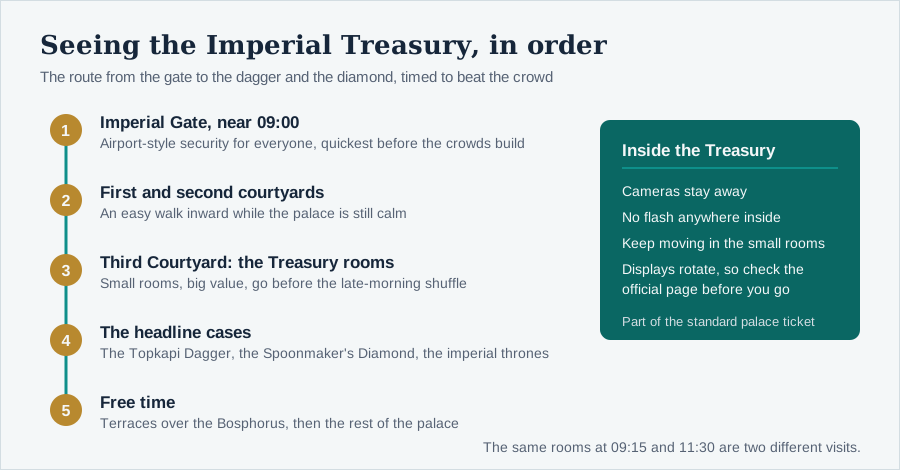
An early arrival near the 09:00 opening is the single best move, letting you stand in front of the dagger and the diamond without a scrum. The featured guided ticket adds a licensed guide who can tell you what you are looking at, which matters here, since the objects carry stories that are invisible on sight. It also includes the Harem, so you can pair the palace's two headline sections in one calm morning; how long to spend at Topkapı breaks down what that pairing does to your timings. Prefer to wander alone? The cheaper skip-the-line audio ticket covers the palace with hosted Harem entry at your own pace, and our guided vs audio-guide comparison sets the two side by side. If a specific piece is on your must-see list, check the official site close to your visit, since displays do change.
Frequently asked questions
What is in the Imperial Treasury at Topkapı Palace?
The Ottoman dynasty's most precious objects: jewelled weapons, imperial thrones, jewels and ceremonial pieces. The best-known are the emerald-studded Topkapı Dagger and the large diamond commonly called the Spoonmaker's Diamond.
Can you take photos in the Topkapı Treasury?
No, photography is typically not allowed inside the Imperial Treasury, and flash is prohibited throughout the palace's exhibition halls. The nearby Sacred Relics chamber is also strictly no photography.
How big is the Spoonmaker's Diamond?
It is one of the largest diamonds in the world, commonly cited at around 86 carats and set in a ring of smaller stones. It is a long-standing highlight of the Treasury collection.
Is the Topkapı Treasury included in the ticket?
The Treasury is part of the main palace ticket, unlike the Harem, which is separate. The featured guided ticket includes skip-the-line palace entry plus the Harem and a guide.
Is the Treasury always open at Topkapı?
Not always. The Treasury has seen periods of renovation and rearrangement, and individual rooms can close for conservation, so check the official Topkapı Palace site for what is currently on view before your visit.
Choose Your Topkapi Palace Ticket
Initial editorial recommendation. The optional choices below adjust it; the operator confirms final eligibility.
Match the ticket to your plans
Small-Group Topkapi Palace and Harem Tour with Tickets — Same guided Palace-plus-Harem walk in a deliberately small group, bookable through Viator About 3 hours.
Topkapi Palace & Harem Ticket with Audio Guide — It is the self-paced budget route that still skips the ticket queue and now covers the Harem section 20-minute hosted entry option, or a 45-minute highlights tour, then explore with the audio app.
Topkapi Palace & Harem Guided Tour with Ticket
Have a travel date in mind? It removes the sales queue and covers both the Palace and the Harem with a licensed guide. Check your date before arranging the rest of your day.
About 3 hours · Live guide in English or German; headsets provided
Meeting point, inclusions and restrictions
Ersoy Bufe kiosk, Hippodrome/Sultanahmet Square (opposite the German Fountain); guide carries a Walks In Europe sign. Two start-time options.
Includes: Skip-the-line Palace ticket, Harem entry, licensed guide, headsets; free time to keep exploring after the guided part
Good to know: Free cancellation up to 24 hours before; reserve now, pay later
Not suitable for wheelchairs or strollers; all visitors pass airport-style security; arrive 15 minutes early, timed entry