The Best Time to Visit Topkapı Palace in 2026
Two choices decide whether you see Topkapı in calm or in a crush: the time of day, and the time of year. Here is how to get both right.
 Written with Mehmet Demir, Istanbul Topkapi Palace ticket specialist

Short answer
The best time to visit Topkapı Palace is early on a weekday morning, right around the 09:00 opening, before the tour groups and cruise crowds arrive by late morning. Across the year, spring, roughly April and May, and autumn, September and October, give the mildest weather and thinner crowds. Avoid Tuesday, when the palace is closed, and avoid midday in peak summer, which is both hottest and busiest.
Stand at the Imperial Gate at 09:00 on a Wednesday in October and Topkapı feels almost private. Stand in the same spot at noon on a July Saturday and you are shuffling through the first courtyard shoulder to shoulder. Same palace, same ticket, completely different day. Timing is the lever, and it costs nothing to pull.
When is the best time to visit Topkapı Palace?
Early on a weekday morning, arriving at or just after the 09:00 opening, is the calmest window, and spring or autumn are the best seasons. Visitor guidance consistently points to the first ninety minutes of the day, before roughly 10:30, as the quiet stretch, with the crowds building steadily through late morning as tour groups and cruise-ship day-trippers arrive.
The reason is straightforward. Topkapı is a fixed set of narrow inner rooms, the Treasury and the Harem above all, that can only hold so many people at once. Early, you move through them freely. By midday, the same rooms bottleneck. Get in first and you see the best sections at their best.
| Window | What it is like |
|---|---|
| 09:00 to about 10:30 | The quiet stretch, the inner rooms move freely |
| Late morning | Tour groups and cruise day-trippers arrive, queues build |
| Midday to mid-afternoon | The peak crush, Treasury and Harem bottleneck |
| Late afternoon | Thinning out, but you are racing the box-office cut-off |
What is the best season to visit Topkapı?
Spring, around April and May, and autumn, September and October, offer the mildest Istanbul weather and lighter crowds than the summer peak. These shoulder seasons keep close to the longer summer opening hours while sparing you the July and August heat and the thickest tourist volumes.
Summer is the busiest and hottest stretch, and the city's own numbers show it: July's foreign-visitor count runs more than half again above January's. Much of Topkapı is open-air, so the courtyards and terraces bake in the afternoon sun with little shade. Winter is the quietest season and can be a fine time to visit if you do not mind cooler, wetter days, though the palace runs shorter hours and the box office closes earlier then. For the balance of comfortable weather, long days and manageable crowds, the shoulder seasons win.

Which days and times should you avoid?
Avoid Tuesday entirely, since the palace is closed, and avoid the midday-to-early-afternoon window on weekends and peak-summer days, when it is busiest. The Tuesday closure is listed on the official National Palaces page, and there is no ticket that opens the gates that day; the full picture of hours, box office and closed days has its own guide.
| Day | Call it |
|---|---|
| Tuesday | Closed, no ticket changes that |
| Weekdays other than Tuesday | The best pick, especially at opening |
| Saturday and Sunday | Local visitors join the crowd, go early |
| School and public holidays | Spike days, treat them like weekends |
Weekends draw local visitors on top of the international crowd, and the middle of the day is when tour groups and cruise passengers converge. If a weekend is your only option, get there for opening and see the Harem and Treasury before the surge. School holidays and major public holidays also spike the numbers, something to plan around doubly if you are visiting with kids, so if your dates fall on one, an early arrival matters even more.
Weather, crowds and the trade-off
There is a small trade-off: the quietest season, winter, has the least pleasant weather, while the best weather, summer, brings the biggest crowds. The shoulder seasons thread that needle, which is why I point most visitors toward them.
| Istanbul foreign visitors | January | July |
|---|---|---|
| 2024 | 1,165,996 | 1,905,146 |
| 2025 | 1,268,660 | 1,879,266 |
Because a large share of Topkapı is outdoors, weather shapes the day more than at an enclosed museum. A bright spring morning on the terraces overlooking the Bosphorus is the palace at its finest. A crowded, sweltering summer afternoon is the palace at its most trying. If your dates are fixed in high summer, you can still have a great visit by going early and using the shaded interiors, the Treasury and the Harem, during the hottest hours.
Timing it with your ticket
Whatever season you land in, an early-morning entry is the move, and a dated skip-the-line ticket is how you protect it. Buying at the gate on a busy morning means queueing at the sales window while the crowd builds, which eats the very quiet you got up early for. With a dated ticket you walk to the entry lane instead. The featured guided ticket includes the Harem, so an early slot lets you take the palace's busiest inner section while it is still calm, then move out to the terraces as the day fills.
What does Topkapı feel like month by month?
Broadly: cold and quiet from December to February with shorter hours, mild and rising through March to May, hot and packed from June to August, then easing back to mild and pleasant across September and October. The spring and autumn edges are the sweet spot, and the city's own visitor numbers back that summer-heavy shape. Pick a shoulder month and you get near-summer daylight without the crush.
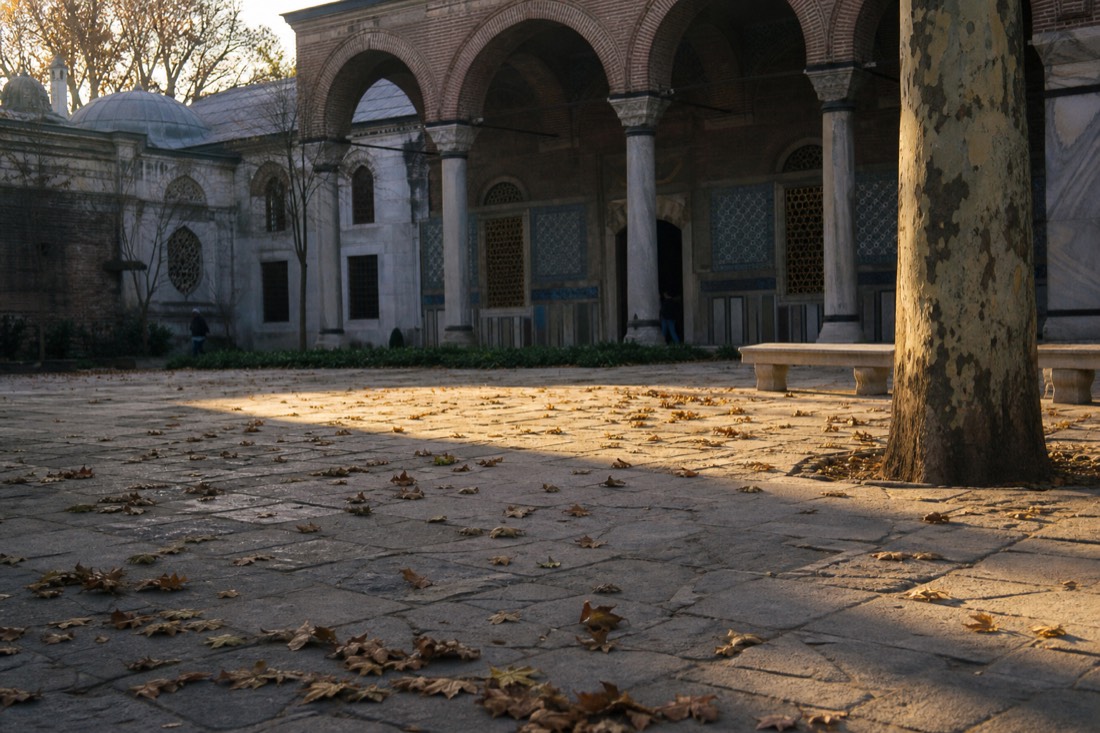
The month you choose changes two things at once: the weather on the open-air courtyards and terraces, and the size of the crowd funnelling through the narrow inner rooms. Istanbul's foreign-visitor figures peak hard in July and bottom out in January, and Topkapı, as the city's most visited palace, feels that curve directly.
Read the table as a planning allowance rather than a forecast. Weather varies year to year, and a mild February morning can beat a rainy May one, but the broad shape holds season after season.
| Months | Crowds | Comfort outdoors | Note |
|---|---|---|---|
| December to February | Lightest of the year | Cool, wetter, can be cold on the terraces | Shorter hours, box office closes earlier |
| March to May | Rising, still manageable | Mild and bright, ideal for the courtyards | Longer daylight returning |
| June to August | Heaviest, peak season | Hot, little shade outdoors in the afternoon | Go early, use the shaded interiors midday |
| September to October | Easing from the peak | Mild and comfortable again | Close to summer hours without the heat |
If your dates are fixed in high summer, the fix is not to give up but to shift your hours: arrive at opening for the outdoor courtyards, then move into the Treasury and Harem during the hottest part of the afternoon.
Spring and autumn earn their reputation for a reason beyond the mild air. In April and May the courtyards are in fresh leaf and the terraces are comfortable to stand on for a while, which is exactly where the Bosphorus views are. September and October hold onto the longer daylight while the summer crowds thin, so you get more open hours and fewer people in the same window. Those are the months I steer visitors toward whenever the dates are theirs to choose.
Winter deserves a fairer hearing than it usually gets. December through February is the quietest stretch of the year, so the inner rooms that bottleneck in July move freely, and a crisp, clear morning on the terraces over the Bosphorus can be one of the best versions of the visit. The trade-offs are real: shorter opening hours, an earlier box-office cut-off, and a genuine chance of cold, wet weather on the open-air stretches. If you would rather have the Harem almost to yourself than have warm sun, winter is a defensible pick, provided you check the official page for that day's hours before you go.
Scale is the thing to keep in mind through all of this. Topkapı is the busiest of Turkey's National Palaces and one of the most visited museums anywhere, so even a quiet month is not an empty one, and a busy month funnels an enormous crowd into a fixed set of rooms. That is why the time-of-day advice holds in every season. The month sets the size of the crowd; the hour decides whether you are ahead of it or standing in the middle of it.
What does an early-morning visit look like hour by hour?
Arrive around 08:45 to clear security near opening, walk the first courtyards from 09:00 while they are near empty, take the Treasury and the Harem before the tour groups build toward 10:30, then move out to the terraces as the site fills. The whole calm window is roughly the first ninety minutes. Front-load the sections that bottleneck and you beat the crush to each of them.
The logic is simple. The inner rooms, the Treasury and the Harem above all, are narrow and can hold only so many people, so they clog first once the late-morning groups arrive. Do them early, while the gate has only just opened, and you see them at their calmest.
The worked timeline below is a planning allowance built around the 09:00 opening and the quiet window that runs to about 10:30. Shift it earlier or later to taste, but keep the order: inner rooms first, open courtyards and terraces once the crowd is in.
| Time | Where to be | Why |
|---|---|---|
| Around 08:45 | At the Imperial Gate for security | The security line is shortest before opening |
| 09:00 to 09:20 | The first and second courtyards | Near empty, good light, easy photos outdoors |
| 09:20 to 10:00 | Imperial Treasury and Sacred Relics | The narrow rooms are still uncrowded |
| 10:00 to 10:30 | The Harem | Take it before the groups reach it |
| After 10:30 | Terraces and remaining courtyards | Open-air space absorbs the building crowd |
By late morning the same route in reverse would mean queueing at every inner door, which is exactly the experience the early start avoids.
One wait sits outside this timeline and cannot be planned away: the airport-style security at the Imperial Gate, which everyone passes through and no ticket skips. That is the strongest argument for the 08:45 arrival. The security line is at its shortest just before opening and grows through the morning, so the earlier you reach it, the less of your day it eats. Get through it near opening and the whole itinerary above stays on schedule; hit it at noon and you can lose the first half hour before you even see a courtyard.
For contrast, picture the opposite arrival. Reach the gate at 11:30 and you meet the security queue at its fullest, then step into courtyards already thick with tour groups, then queue again at the Treasury and once more at the Harem door. Same ticket, same rooms, an entirely heavier day. Nothing about the palace changed. Only the clock did, and the clock is the one variable you fully control.
When are the Treasury and Harem calmest?
Both are calmest in the first hour after the 09:00 opening and busiest from late morning through mid-afternoon, because they are the narrowest, most sought-after rooms in the palace and they bottleneck fastest. If you want either at its best, make it your first stop, not your last. These two rooms, more than the courtyards, decide whether the visit feels calm or cramped.
The open courtyards can absorb a big crowd and still feel spacious. The Treasury and the Harem cannot. They are the reason an early arrival matters so much at Topkapı specifically: it is not about the gate queue alone, it is about reaching the pinch points before everyone else does.
| Inner section | Calmest window | Bottlenecks | Planning move |
|---|---|---|---|
| Imperial Treasury | First hour after opening | Late morning onward | Head there before the courtyards fill |
| The Harem | First hour to about 10:30 | Midday to mid-afternoon | Do it early, it needs a separate ticket |
| Sacred Relics chamber | First hour after opening | Late morning onward | Pair it with the Treasury early |
This is also why the order of your visit matters as much as the hour. Plenty of people drift through the courtyards first, because that is what greets you at the gate, then reach the Treasury and Harem exactly as the late-morning surge arrives. Flip it. Let the open-air courtyards, which shrug off a crowd, wait until later, and spend your quietest first hour where the walls are closest together.
There is a quieter bonus to reaching those rooms early. Photography is limited in parts of the palace, banned in the Sacred Relics chamber and typically in the Treasury, so what you carry away from them is the looking itself rather than the photo. Doing them in the calm of the first hour, without a crowd pressing behind you, is the difference between glancing and actually seeing.
The featured guided ticket includes the Harem, so an early dated slot lets you take the palace's busiest inner section while it is still quiet, then drift out to the terraces as the day fills.
What I tell visitors about timing their day
The ticket gets planned carefully and then the timing is left to chance, which is backwards. At Topkapı the hour you walk through the gate matters more than almost any other choice you make about the day.

I give every visitor the same three lines: come on any day but Tuesday, be at the gate for the 09:00 opening rather than after it, and aim for a spring or autumn date if the trip is still flexible. The first ninety minutes are a different palace from the afternoon, and the difference costs nothing but an early alarm and a skipped hotel breakfast.
The rest is the calendar. Tuesday is closed, no ticket changes that, so I steer people to any other weekday. Weekends bring local families on top of the international crowd, and school and public holidays behave like weekends, so on those dates the early start is not optional. If the dates are open, spring or autumn gives the mild weather and the thinner crowds together, which is the one combination high summer never offers.
Mehmet Demir has specialised in Topkapı Palace tickets since 2012. A lifelong Istanbul resident with deep Ottoman-history knowledge, he has helped more than 1,000 international visitors plan their way through the palace.
Frequently asked questions
What is the best time of day to visit Topkapı Palace?
Early on a weekday morning, right around the 09:00 opening. The quiet window runs until about 10:30, after which tour groups and cruise crowds build through late morning. See the Harem and Treasury first.
What is the best month to visit Topkapı Palace?
The spring months of April and May and the autumn months of September and October give the mildest weather and thinner crowds than the summer peak, while keeping close to the longer opening hours.
Is Topkapı Palace crowded?
It gets busy from late morning through the afternoon, especially on weekends and in peak summer, because the Treasury and Harem are narrow rooms that bottleneck. An early arrival is the simplest way to avoid the crush.
What day is Topkapı Palace closed?
Tuesday. The palace is closed all day, as listed on the official Topkapı Palace Museum pages, so plan another Istanbul sight for that day.
Is it worth visiting Topkapı in winter?
Yes, if you do not mind cooler, wetter weather. Winter is the quietest season, though the palace runs shorter hours and the box office closes earlier, so check the official page for that day's times.
Choose Your Topkapi Palace Ticket
Initial editorial recommendation. The optional choices below adjust it; the operator confirms final eligibility.
Match the ticket to your plans
Topkapi Palace & Harem Ticket with Audio Guide — It is the self-paced budget route that still skips the ticket queue and now covers the Harem section 20-minute hosted entry option, or a 45-minute highlights tour, then explore with the audio app.
Istanbul Old City Tour: Hagia Sophia, Blue Mosque & Grand Bazaar — It gives the rest of Sultanahmet a guide and a route while Topkapi stays your own visit About 4 hours.
Topkapi Palace & Harem Guided Tour with Ticket
Have a travel date in mind? It removes the sales queue and covers both the Palace and the Harem with a licensed guide. Check your date before arranging the rest of your day.
About 3 hours · Live guide in English or German; headsets provided
Meeting point, inclusions and restrictions
Ersoy Bufe kiosk, Hippodrome/Sultanahmet Square (opposite the German Fountain); guide carries a Walks In Europe sign. Two start-time options.
Includes: Skip-the-line Palace ticket, Harem entry, licensed guide, headsets; free time to keep exploring after the guided part
Good to know: Free cancellation up to 24 hours before; reserve now, pay later
Not suitable for wheelchairs or strollers; all visitors pass airport-style security; arrive 15 minutes early, timed entry